Annotations, Allusions, and Annabel Lee
Nabokov Nights, Week 1 & 2

Update: I have a bit of a medical issue going on which is affecting my hands. Unfortunately, holding a book has been painful so I've switched to reading on my Kindle and then going back and annotating my copy after reading. Anyway, all of this to say, I'm sorry I was late on Week 1! I have decided just to send out the first two weeks together in this post so we don’t get behind schedule:
My annotation break down:
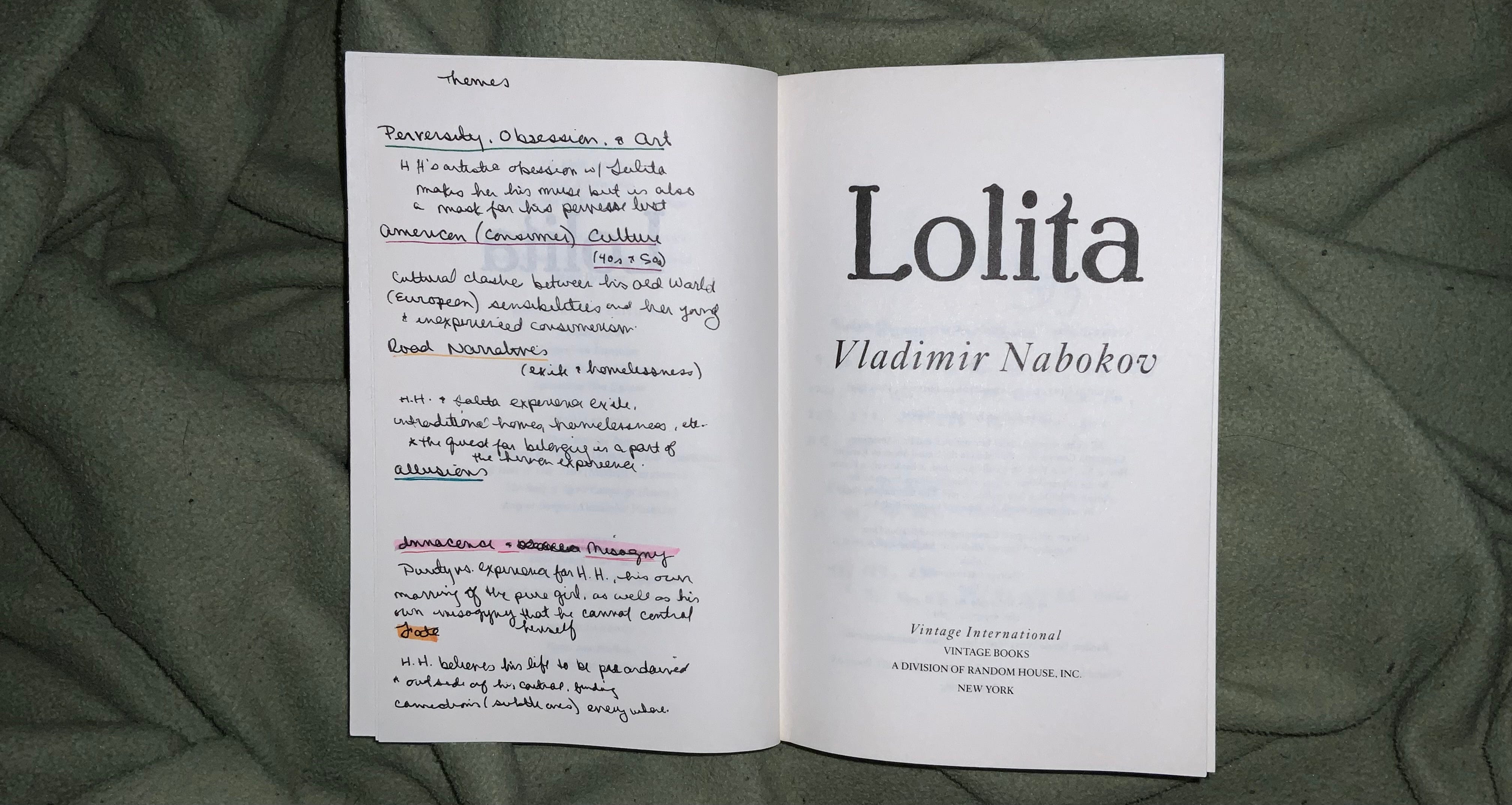
Perversity, Obsession & Art: Green
Consumer Culture (40s & 50s America): Purple
Road Narratives: Yellow
General Allusions: Blue
Innocence & Misogyny: Pink highlighter
Fate: Orange highlighter
Butterfly/entomological allusions: Butterfly stickers
Definitions: underlined in black
Week 1, February 16th - 22nd: Chapters 1-3 Summaries
Foreword
The psychologist John Ray, Jr., Ph.D., writes the foreword to Lolita, also known as “Confession of a White Widowed Male.” This foreword is dated 1955. It is important to note, Lolita purposely parodies psychoanalysis. Nabokov openly hated Freud so much, he was asked about it in an interview in 1966. Nabokov said about Freud, “I think he’s crude, I think he’s medieval, and I don’t want an elderly gentlemen from Vienna with an umbrella inflicting his dreams upon me. I don’t have the dreams that he discusses in his books. I don’t see umbrellas in my dreams. Or balloons.” For further proof of his parody, from page 3, Blanche Schwarzmann is a parody as well. Schwarz is German for “black” so her name is “White Blackman.” He names her this because, to Nabokov, Freudians figuratively see no color beside black and white.
Ray writes that Humbert Humbert, Lolita’s author, died in captivity in 1952, a few days before his trial was scheduled to start.
Humbert Humbert is not the author’s real name.
His real name, along with many others in the upcoming narrative, have been changed for privacy reasons.
Humbert Humbert (HH, going forward), the double rumble of this name, according to Nabokov in 1962, should be “very nasty, very aggressive. It is a hateful name for a hateful person.” I love this mentioning of the rumbling of Humbert’s name because it is a direct comparison to how HH describes Lolita at the open of Chapter One (Which opens on the same word as the Foreword: Lolita.): “Lo-Lee-Ta: the tip of the tongue taking a trip of three steps down the palate to tap, at three, on the teeth. Lo. Lee. Ta.”
HH’s lawyer sent the manuscript to Ray to edit after his client’s death.
Ray does not name HH’s crime.
But he does suggest that the “disaster” might have been prevented if HH saw a competent psycho-pathologist.
Ray writes that Mrs. Richard F. Schiller died in childbirth on Christmas Day 1952.
Mrs. Richard F. Schiller is Dolores, or Lolita. Her child did not survive.
Ray calls HH “horrible.”
But he suggests that HH’s writing and compassion for Lolita can make the reader “entranced with the book while abhorring its author.”
Ray ends his foreword by suggesting that Lolita should remind readers of the importance of bringing up “a better generation in a safer world.”
Chapter 1
HH describes Lolita.
She is “light of my life, fire of my loins.”
She is four feet ten inches tall.
“She was Lola in slacks. She was Dolly at school. She was Dolores on the dotted line. But in my arms she was always Lolita.” Lolita’s first name is Dolores. Lola is a diminutive of Dolores, which was derived from the Latin, “dolor” which means sorrow and pain,
Humbert says Lolita had a precursor, an initial “girl-child,” and we see the first allusions to Poe’s Annabelle Lee.
Chapter 2
HH describes his upbringing.
He was born in 1910 in Paris and lived in the hotel his father owned.
His mother died when he was three years old.
His aunt Sybil helped raise him.
Sybil died a little after his 16th birthday. She knew she would die, which is the first real mythical allusion towards women in his life.
Before turning 13, HH says, he had hardly any sexual experience.
He had a discussion of puberty with another boy.
He looked at some nude paintings.
His father gave him “all the information he thought I needed about sex.”
Chapter 3
HH describes Annabel Leigh, Lolita’s predecessor.
He says he can’t remember her appearance as well after knowing Lolita.
She was a “lovely child” a little younger than Humbert.
HH says he and Annabel fell in love.
They exchanged secret touches and kisses when possible.
This experience drove their young bodies to exasperation.
One day they snuck off to the beach together, but were interrupted by two men coming out of the sea.
Annabel died four months after this event, of typhoid.
Notes

Annabel Lee
It was many and many a year ago,
In a kingdom by the sea,
That a maiden there lived whom you may know
By the name of Annabel Lee;
And this maiden she lived with no other thought
Than to love and be loved by me.
I was a child and she was a child,
In this kingdom by the sea,
But we loved with a love that was more than love—
I and my Annabel Lee—
With a love that the wingèd seraphs of Heaven
Coveted her and me.
And this was the reason that, long ago,
In this kingdom by the sea,
A wind blew out of a cloud, chilling
My beautiful Annabel Lee;
So that her highborn kinsmen came
And bore her away from me,
To shut her up in a sepulchre
In this kingdom by the sea.
The angels, not half so happy in Heaven,
Went envying her and me—
Yes!—that was the reason (as all men know,
In this kingdom by the sea)
That the wind came out of the cloud by night,
Chilling and killing my Annabel Lee.
But our love it was stronger by far than the love
Of those who were older than we—
Of many far wiser than we—
And neither the angels in Heaven above
Nor the demons down under the sea
Can ever dissever my soul from the soul
Of the beautiful Annabel Lee;
For the moon never beams, without bringing me dreams
Of the beautiful Annabel Lee;
And the stars never rise, but I feel the bright eyes
Of the beautiful Annabel Lee;
And so, all the night-tide, I lie down by the side
Of my darling—my darling—my life and my bride,
In her sepulchre there by the sea—
In her tomb by the sounding sea.
Week 2, February 23rd - 29th: Chapters 4-6
Chapter 4
Humbert asks himself whether his thwarted desire for Annabel was what caused his later issues, or if instead it was only the first evidence of the problem already existing inside him.
He is convinced that his experience with Lolita began with Annabel.
He describes his first sexual encounter with Annabel.
They snuck off to a mimosa grove while the adults played cards and used their hands to pleasure one another.
Humbert focuses intently on the beauty of the scene around them, including the night sky and Annabel’s smell.
But they were interrupted and Humbert says “the ache remained with me.”
He says he was unable to break away from Annabel’s spell only after 24 years, when he “incarnated her” in Lolita.
Chapter 5
HH recalls his college days in London and Paris.
At the time, he hired prostitutes.
He considered studying psychiatry, but ended up switching to English literature.
Eventually, he began writing a manual of French literature for English speakers.
He says the last volume of this manual was nearly finished by the time of his arrest.
HH now describes his obsession with “nymphets.”
Nymphets are certain girls between ages 9 and 14 that possess a mysterious grace and charm.
HH says he and certain older men are able to discern which girls are nymphets and which are not.
HH has intense sexual feelings for nymphets.
During his time in Europe, he hid that desire amid relationships with women his age.
But he says those relationships were nothing compared to the “incomparably more poignant bliss” of his longed-for sex with a nymphet.
Partly to justify his pedophilic urges, HH cites a number of examples of older men falling for prepubescent girls.
The Italian authors Dante and Petrarch are two examples. (See Notes below for more on this.)
He imagines making sexual contact with the nymphets he sees playing at the park.
Chapter 6
HH recounts hiring a French prostitute named Monique.
Monique was too old to be a nymphet, but was young enough to serve as a nymphet substitute for HH.
HH says Monique was the only sexual experience with a prostitute that gave him a “pang of genuine pleasure.”
He speculates that she had been a nymphet when she was younger.
Bolder after his experience with Monique, HH tries to find an even younger prostitute.
An asthmatic woman brings him to her home and suggests he have sex with a girl there.
But the girl repulses HH with her plainness and he thinks she is at least 15.
When he tries to leave, the woman calls in two men.
The men force HH to pay them to prevent them reporting him to the police.
He pays them and leaves.
Notes
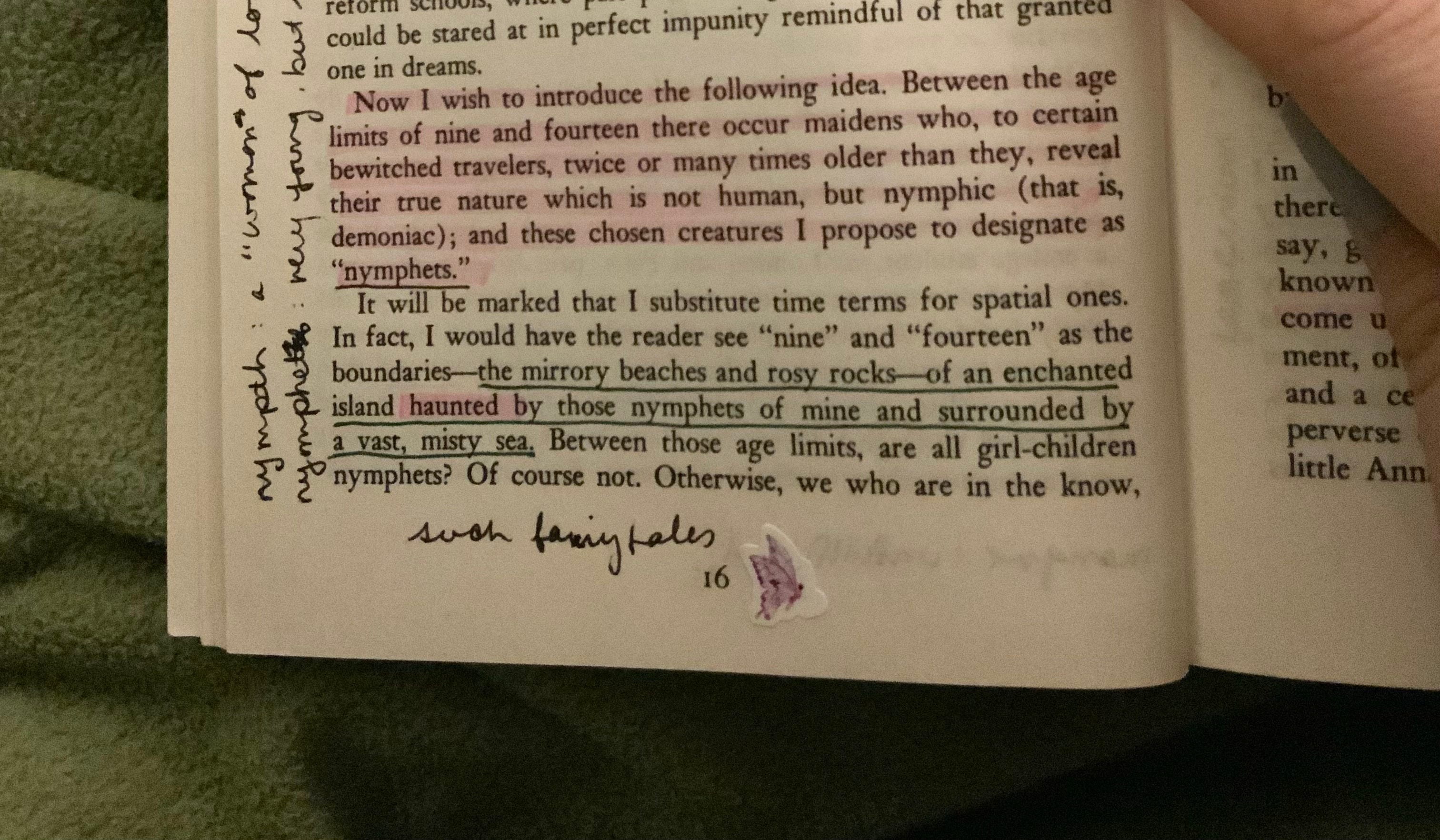
I’m not going to lie, I nerded out a bit at the first appearance of the word “nymphet.”
“Now I wish to introduce the following idea. Between the age limits of nine and fourteen there occur maidens who, to certain bewitched travelers, twice or many times older than they, reveal their true nature which is not human, but nymphic (that is, demoniac); and these chosen creatures I propose to designate as “nymphets.”
Nymph: a woman of loose morals.
— Webster’s Dictionary (echoed by Random House Dictionary
Nymphet: (coll.) very young but sexually attractive girl.
— The Penguin English Dictionary
The differences in those two definitions are quite obvious, but what's most interesting to me is, in Greek and Roman mythology, nymphs are inferior divinities of nature represented by beautiful maidens dwelling in the mountains, waters, forests, etc. Jorge Luis Borges defines nymphs in his The Book of Imaginary Beings (1969), “nymphs were held to be immortal. […] Glimpsing them could cause blindness and, if they were naked, death.”
Humbert echoes these definitions and in the following pages alludes to “spells,” “magic,” fantastic powers,” and “deadly demons.” Lolita’s “inhuman” and “bewitching charms” suggest she is Keats’s “La Belle Dame Sans Merci” but in bobby socks. It is a tale of a mortal destroyed by his love for a supernatural femme fatale.
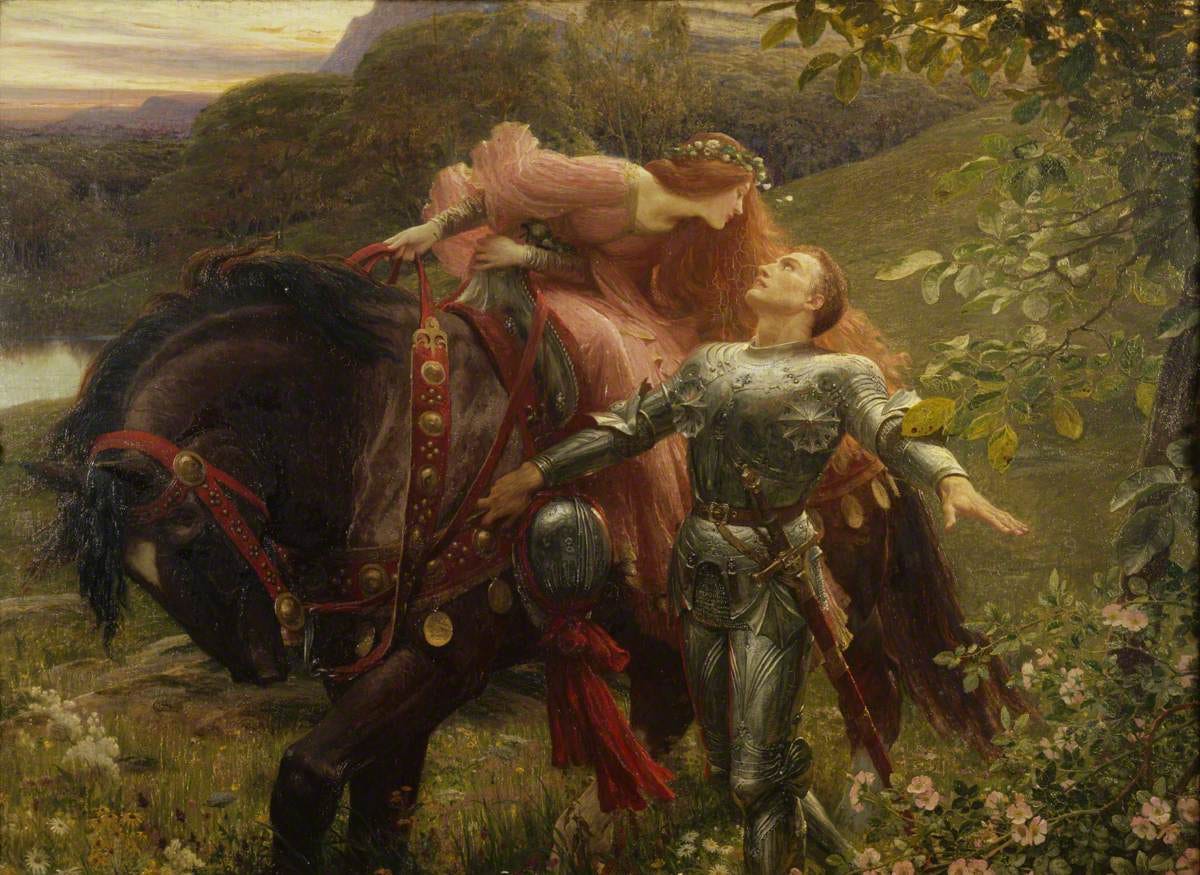
La Belle Dame sans Merci: A Ballad
BY JOHN KEATS
O what can ail thee, knight-at-arms,
Alone and palely loitering?
The sedge has withered from the lake,
And no birds sing.
O what can ail thee, knight-at-arms,
So haggard and so woe-begone?
The squirrel’s granary is full,
And the harvest’s done.
I see a lily on thy brow,
With anguish moist and fever-dew,
And on thy cheeks a fading rose
Fast withereth too.
I met a lady in the meads,
Full beautiful—a faery’s child,
Her hair was long, her foot was light,
And her eyes were wild.
I made a garland for her head,
And bracelets too, and fragrant zone;
She looked at me as she did love,
And made sweet moan
I set her on my pacing steed,
And nothing else saw all day long,
For sidelong would she bend, and sing
A faery’s song.
She found me roots of relish sweet,
And honey wild, and manna-dew,
And sure in language strange she said—
‘I love thee true’.
She took me to her Elfin grot,
And there she wept and sighed full sore,
And there I shut her wild wild eyes
With kisses four.
And there she lullèd me asleep,
And there I dreamed—Ah! woe betide!—
The latest dream I ever dreamt
On the cold hill side.
I saw pale kings and princes too,
Pale warriors, death-pale were they all;
They cried—‘La Belle Dame sans Merci
Thee hath in thrall!’
I saw their starved lips in the gloam,
With horrid warning gapèd wide,
And I awoke and found me here,
On the cold hill’s side.
And this is why I sojourn here,
Alone and palely loitering,
Though the sedge is withered from the lake,
And no birds sing.
Source: Selected Poems (Penguin Classics, 1988)
And then on page 17, Nabokov uses the word “nympholet” which is defined by Blakiston’s New Gould Medical Dictionary, “ecstasy of an erotic type.”
BUT! And here is where it gets fun. Nabokov was a devout Lepidopterist.
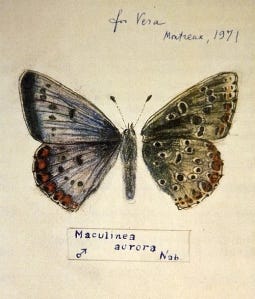
As I mentioned in my annotation breakdown, I am tracking the entomological allusions to insects and butterflies in my own copy with butterfly stickers. But in doing so, it is important to note that Nabokov made is clear he wrote HH to purposely confuse certain butterflies for a hummingbird, etc. So while butterfly motifs are so Nabokov, I love that he refused to share his passion with HH. Anyway, back to nymphs:
One of Nabokov’s lepidopterological finds became known as, “Nabokov’s Wood-Nymph” so he was very much aware that nymphs are also defined as “pupa” or “the young of an insect undergoing incomplete metamorphosis.”
As we read, these stages of Lolita’s life becomes more obvious in his intent. He is admitting from the start, Lolita is a young person in the middle of an incomplete metamorphosis into adulthood and what HH does and thinks is wrong. Even more than that, I am going to try to track the stages of Lolita’s life as if this were a scientist tracking her growth: Dolores turning into Lolita, Humbert’s lust morphs into love, etc. Because, according to Nabokov, “a metamorphosis is always exciting to watch.”
Now, finally, here are the allusions HH uses to prove his appetites for the nymphet “okay,” starting at the bottom of Page 18 through page 19:
At other times I would tell myself that it was all a question of attitude, that there was really nothing wrong in being moved to distraction by girl-children. Let me remind my reader that in England, with the passage of the Children and Young Person Act in 1933, the term "girl-child" is defined as "a girl who is over eight but under fourteen years" (after that, from fourteen to seventeen, the statutory definition is "young person").
The Act actually reads: “Child” means a person under the age of fourteen years old… ‘Young Person’ means a person who has attained the age of fourteen years and is under the age of seventeen years. (From Children and Young Persons Act of 1933, 23 &24 Geo. 5, c. 12, 107 (1). No specific definition of girl-child is given.
In Massachusetts, U.S., on the other hand, a "way-ward child" is, technically, one "between seven and seventeen years of age" (who, moreover, habitually associates with vicious or immoral persons).
This is an accurate transcription from Mass. Anno. Laws ch. 119, 52 (1957). HH seems to be a legal scholar when it comes to the legality of children.
Hugh Broughton, a writer of controversy in the reign of James the First, has proved that Rahab was a harlot at ten years of age.
First, Hugh Broughton is a controversial Puritan divine and pamphleteer, and HH is referring to A Consent of Scripture (1588), an eccentric discourse on Biblical chronology. Secondly, Rahab is a Canaanite prostitute of Joshua 2:1-21:
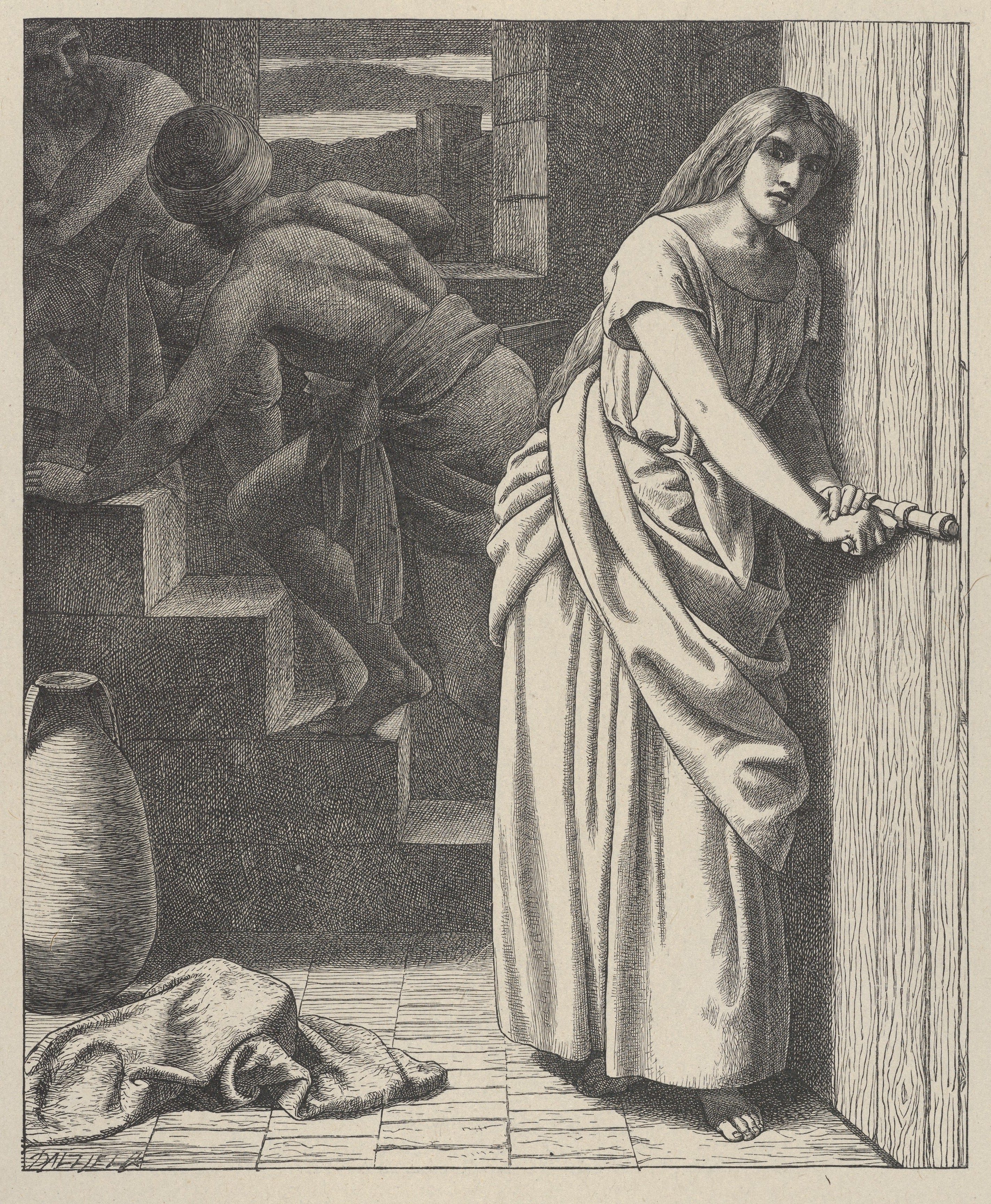
Rahab and the Spies
2 Then Joshua son of Nun secretly sent two spies from Shittim. “Go, look over the land,” he said, “especially Jericho.” So they went and entered the house of a prostitute named Rahab and stayed there.
2 The king of Jericho was told, “Look, some of the Israelites have come here tonight to spy out the land.” 3 So the king of Jericho sent this message to Rahab: “Bring out the men who came to you and entered your house, because they have come to spy out the whole land.”
4 But the woman had taken the two men and hidden them. She said, “Yes, the men came to me, but I did not know where they had come from. 5 At dusk, when it was time to close the city gate, they left. I don’t know which way they went. Go after them quickly. You may catch up with them.” 6 (But she had taken them up to the roof and hidden them under the stalks of flax she had laid out on the roof.) 7 So the men set out in pursuit of the spies on the road that leads to the fords of the Jordan, and as soon as the pursuers had gone out, the gate was shut.
8 Before the spies lay down for the night, she went up on the roof 9 and said to them, “I know that the Lord has given you this land and that a great fear of you has fallen on us, so that all who live in this country are melting in fear because of you. 10 We have heard how the Lord dried up the water of the Red Sea[a] for you when you came out of Egypt, and what you did to Sihon and Og, the two kings of the Amorites east of the Jordan, whom you completely destroyed.[b] 11 When we heard of it, our hearts melted in fear and everyone’s courage failed because of you, for the Lord your God is God in heaven above and on the earth below.
12 “Now then, please swear to me by the Lord that you will show kindness to my family, because I have shown kindness to you. Give me a sure sign 13 that you will spare the lives of my father and mother, my brothers and sisters, and all who belong to them—and that you will save us from death.”
14 “Our lives for your lives!” the men assured her. “If you don’t tell what we are doing, we will treat you kindly and faithfully when the Lord gives us the land.”
15 So she let them down by a rope through the window, for the house she lived in was part of the city wall. 16 She said to them, “Go to the hills so the pursuers will not find you. Hide yourselves there three days until they return, and then go on your way.”
17 Now the men had said to her, “This oath you made us swear will not be binding on us 18 unless, when we enter the land, you have tied this scarlet cord in the window through which you let us down, and unless you have brought your father and mother, your brothers and all your family into your house. 19 If any of them go outside your house into the street, their blood will be on their own heads; we will not be responsible. As for those who are in the house with you, their blood will be on our head if a hand is laid on them. 20 But if you tell what we are doing, we will be released from the oath you made us swear.”
21 “Agreed,” she replied. “Let it be as you say.”
So she sent them away, and they departed. And she tied the scarlet cord in the window.
This is all very interesting, and I daresay you see me already frothing at the mouth in a fit; but no, I am not; I am just winking happy thoughts into a little tiddle cup. Here are some more pictures. Here is Virgil who could the nymphet sing in single tone, but probably preferred a lad's perineum.
Virgil, as in, the Latin poet from 70 - 19 B.C. The word perineum includes urilogical passages and the rectum. The first edition of the book read “peritonium” which is the double serous membrane which lines the cavity of the abdomen. HH’s grotesque error was very much on purpose, but Nabokov feared the mistake would either be mistaken as his, or remain ambiguous, and so changed it.
Here are two of King Akhnaten's and Queen Nefertiti's pre-nubile Nile daughters (that royal couple had a litter of six), wearing nothing but many necklaces of bright beads, relaxed on cushions, intact after three thousand years, with their soft brown puppybodies, cropped hair and long ebony poignant bliss. The dime eyes.
King Akhnaten of Egypt reigned from 1375-1358 B.C. and with Nefertiti had a total of seven daughters. On his momuments, however, there is only ever six.
Here are some brides of ten compelled to seat themselves on the fascinum, the virile ivory in the temples of classical scholarship.
Fascinum: Latin; a penis of ivory used in certain ancient erotic rites.
Marriage and cohabitation before the age of puberty are still not uncommon in certain East Indian provinces. Lepcha old men of eighty copulate with girls of eight, and nobody minds.
The Lepchas are a Mongoloid people of Sikkim and the Darjeeling district of India. What HH says is true, and Nabokov thought HH would have gotten it from Studies in the Psychology of Sex (1891).
After all, Dante fell madly in love with his Beatrice when she was nine, a sparkling girleen, painted and lovely, and bejeweled, in a crimson frock, and this was in 1274, in Florence, at a private feast in the merry month of May.
Dante, of Dante’s Inferno, was born between May 15 and June 15, 1265. He was therefore nine years old when he met Beatrice in 1274, and she would have been eight. There was no romance.
And when Petrarch fell madly in love with his Laureen, she was a fair-haired nymphet of twelve running in the wind, in the pollen and dust, a flower in flight, in the beautiful plain as decried from the hills of Vaucluse.
Petrarch was born July 20, 1304. He was twenty-three when he met “Laureen” on April 6, 1327. She remains unknown to this day, and all attempts to identify her with historical persons are purely speculative. Her age has never been determined.
I spent so much time on Chapter 5, because it is important to note that HH is sharing that in his young adulthood, he “[tries] to be good,”—he never tries to molest a little girl. Nevertheless, he often visits parks and orphanages to be in the presence of nymphets, fantasizing about scenarios in which he could molest them without fearing the consequences. HH then slyly tries to connect his lust for young girls with his artistic gifts, using famous writers and literary sources as examples. He presents his pedophilia as something aesthetic, rather than something physical. Even his encounters with real little girls become literary: he imagines elaborate scenarios of molestation. When he molests Lolita, Humbert will represent it in the same way: as something aesthetic, rather than something associated with a real and physical girl. It is important to have this in mind as we continue onward.